Elucidating the Shroud of Turin: A Scientific Review of the Claims
The Shroud of Turin is one of the most famous religious artifacts in the world. It is a long linen cloth kept in Turin, Italy, bearing the faint image of a crucified man. For many Christians, it is believed to be the burial cloth of Jesus. For others, it is a medieval relic, an artwork, or a devotional object whose history has been exaggerated over time.
This page is not an argument against faith. It is an argument for intellectual honesty.
In 2024, renewed media attention claimed that new scientific testing suggested the Shroud could date to the first century. That claim spread quickly, especially online, and many people began presenting the Shroud as if science had finally verified its authenticity.
The problem is that the full scientific picture is much more complicated.
When the major claims about the Shroud are examined together its provenance, blood claims, carbon dating, alternative dating methods, image formation, pollen evidence, art history, and modern reproductions the case for the Shroud as a verified first century burial cloth becomes extremely weak.
The Shroud may still have religious or devotional value to some people. But scientifically, it should not be presented as proven evidence of the Resurrection, the Crucifixion, or the historical Jesus.
The Videos
My Approach
The goal here is not to mock belief in the Shroud. The goal is to separate faith conviction from scientific claims. A person can believe the Shroud is authentic as a matter of faith. But if someone claims the Shroud is scientifically proven to be authentic, then the evidence has to be judged scientifically. For this review, claims are grouped into five broad categories:
| Factual | Contested, leaning factual | Contested | Contested, leaning false | False |
|---|---|---|---|---|
| Well-supported and broadly established | Plausible, but not fully settled | Disputed or open to multiple interpretations | Weakly supported, overstated, or likely incorrect | Unsupported or contradicted by stronger evidence |
The burden of proof belongs to the person making the claim. If a claim is not demonstrated, it should not be treated as fact.
What Is Actually Non-Controversial?
Very little. The Shroud of Turin is a linen cloth kept in Turin, Italy. It measures roughly 4.4 meters by 1.1 meters and bears the image of a man who appears to have been crucified. That much is safe to say. Beyond that, the claims become controversial quickly. The Shroud does not have a secure historical record going back to the first century. Its clearly documented history begins in medieval Europe, around the 1350s. That is a serious problem for authenticity claims. A relic alleged to be the burial cloth of Jesus disappears from clear history for over a thousand years, then appears in the Middle Ages exactly the same period indicated by radiocarbon dating. That does not automatically prove forgery. But it is a major red flag.
The Provenance Problem
A central issue is that the Shroud lacks an established chain of custody before the medieval period. By the mid-1300s, the Shroud was associated with Geoffrey de Charny and was being displayed publicly in France. Medieval church figures also raised concerns about it. One bishop denounced it as a forgery, and later church correspondence claimed that an artist had been identified. Again, this does not prove every detail of the Shroud’s origin. But it does mean the Shroud does not have the kind of early, traceable provenance one would expect from the most important Christian relic in history. If the Shroud were truly the burial cloth of Jesus, we would need to explain why it vanishes from clear historical record for roughly 1,300 years and then appears in the exact period to which carbon dating later assigns it. That is the “lineup problem”: the known history and the radiocarbon date line up with each other.
Blood and DNA Claims
Many pro-Shroud arguments focus on the red stains. There may be blood-related material on the Shroud. Some studies have reported substances associated with blood, such as heme or porphyrin-related compounds. There are also claims about serum halos visible under ultraviolet light, which may be consistent with clotted blood transfer. That said, many popular claims go far beyond the evidence.
Claim: “The blood is type AB.”
This is not established. The AB blood-type claim comes from older serological testing, but ancient and contaminated material is notoriously difficult to type reliably. Old samples can produce false or misleading blood-type results, and some ancient remains skew spuriously toward AB. The Shroud’s blood type should be treated as unknown unless confirmed by stronger modern methods.
Claim: “AB blood is Semitic blood.”
This is false. AB blood is not “Semitic blood.” Blood type does not prove ethnicity, and there is nothing about AB blood that specifically identifies someone as Jewish, Middle Eastern, or Semitic.
Claim: “The blood is definitely human.”
This is also not securely proven. Even if the red stains contain blood-related compounds, that does not automatically prove the blood is human. Human and animal blood claims require careful testing, and the evidence is not strong enough to state with certainty that the stains are human blood.
Claim: “Male DNA was found.”
There have been claims about male genetic markers, but the Shroud has been handled, exposed, displayed, repaired, and contaminated over centuries. Later DNA studies found mixed human DNA from many sources, along with plant material and other contaminants. DNA on the Shroud does not identify Jesus, a single individual, or a secure geographic origin.
Claim: “Nanoparticles prove the blood came from a torture victim.”
A 2017 paper made a version of this claim, but that paper was later retracted for methodological reasons. A retracted paper cannot be used as strong evidence.
The Radiocarbon Dating Problem
The most important scientific result remains the 1988 radiocarbon dating. Three laboratories — Oxford, Zurich, and Tucson — tested samples of the Shroud. The result placed the linen between 1260 and 1390 AD with 95% confidence. That date range lands directly in the medieval period, which is also when the Shroud clearly appears in the historical record. This is one of the biggest problems for authenticity.
Claim: “The 1532 or 1997 fires altered the carbon date.”
This is not a good explanation. Fire damage does not magically make ancient linen appear medieval. If modern carbon contamination from fire were the issue, one would expect a shift toward the date of the fire, not conveniently into the 13th or 14th century. The relevant pretreatment procedures are also designed to remove many contaminants. The fire argument is not strong enough to overturn the radiocarbon result.
Claim: “The tested sample came from an invisible medieval repair.”
This is one of the most common arguments against the carbon dating. The idea is that the radiocarbon sample was not original Shroud material but a repaired area woven so skillfully that it blended invisibly into the older cloth. The problem is that this repair has not been demonstrated. It is often called an “invisible weave” precisely because the evidence for it is not visible. Textile experts who have examined or restored the Shroud have argued that such a repair would leave detectable traces. This argument also creates a probability problem. The repair would need to exist exactly where the sample was taken, evade detection, match the surrounding textile closely enough to pass unnoticed, and explain why all three laboratories produced a medieval date. That is possible only by stacking assumptions. This claim becomes even more absurd with you account for linen ageing, and weave class. If the Shroud were of 1st Century origin and was then reparied with 1300s cloth why is there no noticable ageing difference between the supposed 1st Century portion and the 12th Century portion? Additionally the Shroud is comprised of 3 to 1 Harringbone Weave, how did the repariers know this? assertaining that info would require either unweaving the Shroud (which has NEVER happened) or modern equipment in order to see that on the mircoscopic level which they didn't have. Defenders of this idea are left relying on yet another supposed miracle or blind luck.
Claim: “A neutron burst changed the carbon date.”
This is an ad hoc miracle explanation. The idea is that radiation from the Resurrection altered the carbon-14 content of the linen, making a first-century cloth appear medieval. Scientifically, this is not a demonstrated mechanism. It assumes the miracle in order to explain the evidence, then uses that explanation to defend the miracle. That is circular reasoning. A supernatural event cannot be ruled out by science in principle, but it also cannot be used as a scientific explanation unless there is independent evidence for it.
The WAXS Dating Claim
Recent headlines focused on a method called WAXS: Wide-Angle X-ray Scattering. This method looks at changes in cellulose structure inside flax fibers and attempts to correlate those changes with age. A study using this method suggested that a thread from the Shroud may be compatible with a first-century date. This sounds significant until the limitations are considered. WAXS dating depends heavily on assumptions about storage conditions, temperature, humidity, degradation history, contamination, and calibration against known samples. Linen aging is not simple. The Shroud has an uncertain and complex history, which makes those assumptions difficult to justify. The sample size is also a problem. A new dating method needs broad calibration across many known samples before it can overturn an established radiocarbon result. If a method fails to correctly date some known samples, then its result on the Shroud should be treated cautiously. WAXS may be interesting. It may deserve further research. But it does not currently overturn the 1988 radiocarbon dating.
Image Formation Claims
The image on the Shroud is mysterious, but “mysterious” does not mean “miraculous.” Several image claims are true or partly true. The image behaves like a photographic negative. It is superficial, meaning the discoloration is mostly on the outer fibers. It is not simply a heat scorch. It has unusual visual properties. But those facts do not prove authenticity.
The Photo-Negative Claim
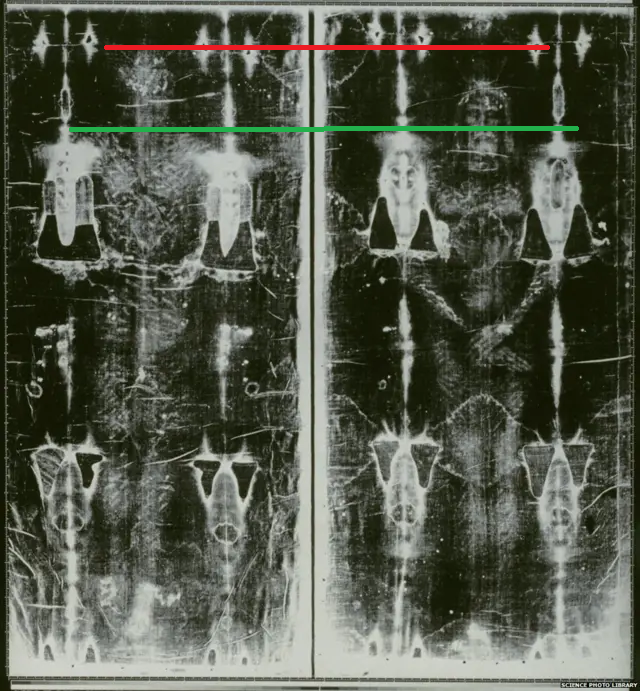
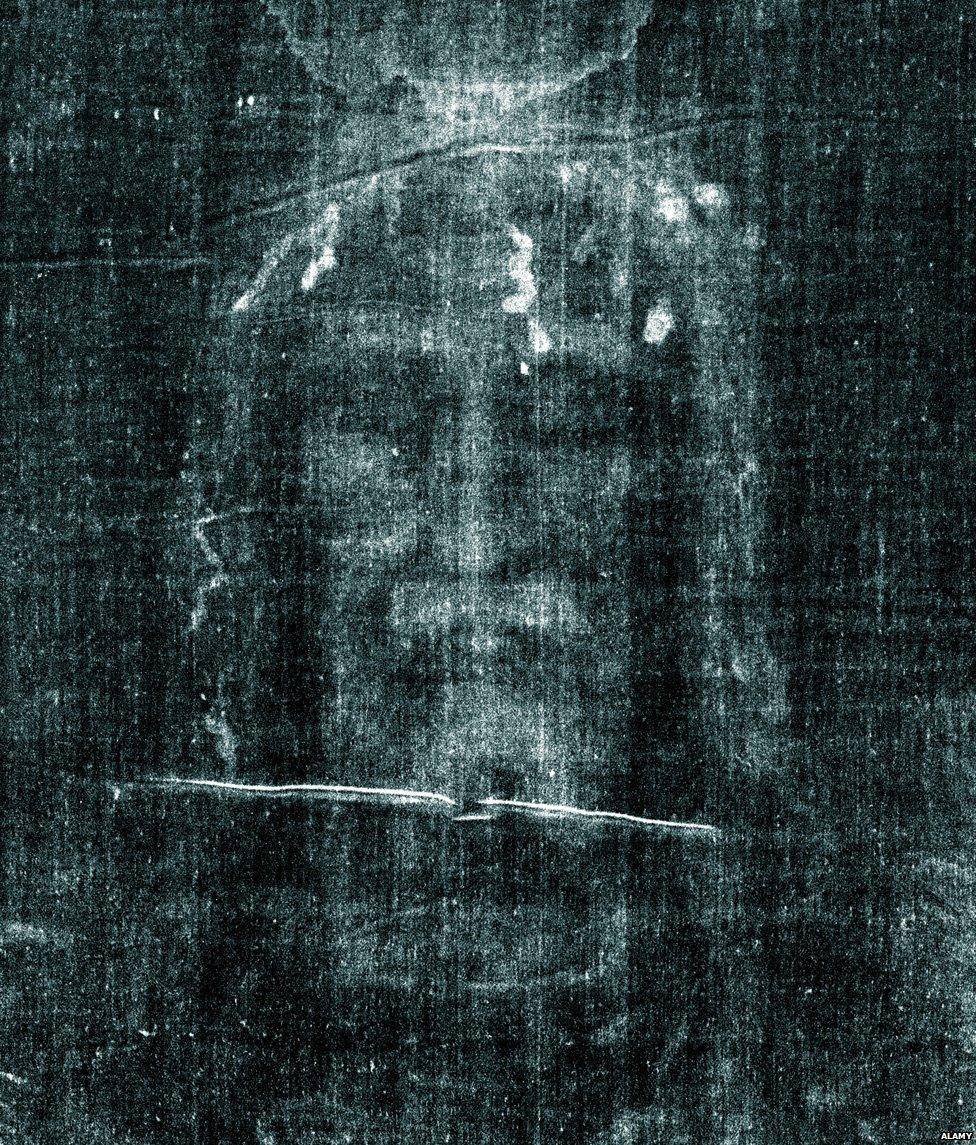
The Shroud’s image does behave like a photographic negative. That is real. However, that does not mean a medieval person needed modern photography to create it. A rubbing or contact-based process can create tonal inversion effects without the maker understanding photography. The fact that the image looks dramatic when photographed in negative is interesting, but it is not proof of a first-century origin. The Proportion Problem The body proportions on the Shroud are anatomically strange. The figure appears elongated and idealized. Depending on how it is measured, it may be interpreted as unusually tall for a first-century Judean man. The body also appears more like an artistic or low-relief form than a natural imprint from a real corpse. This becomes especially obvious when people try to reconstruct the figure in 3D. The result does not behave like a normal human body wrapped in cloth.
The Agamemnon Mask Effect
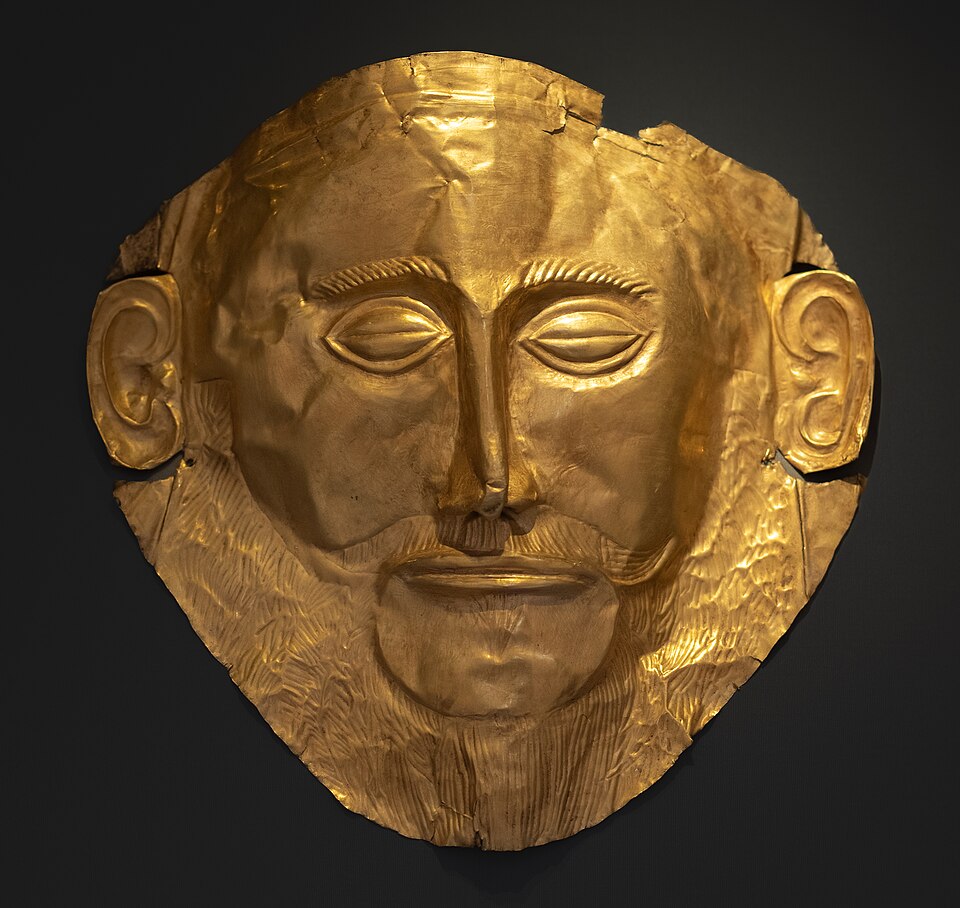
If cloth were wrapped around a three-dimensional human face and somehow received an image from direct contact or radiation, flattening that cloth should produce distortion. The sides of the face should spread outward on the flat surface. This is sometimes called the “Agamemnon mask effect.” The Shroud does not show the kind of side distortion expected from a wrapped cloth receiving a real three-dimensional facial image. This is a serious problem for direct body-contact theories. A low-relief rubbing or artistic process explains this better than a cloth wrapped naturally around a corpse. Front and Back Inconsistencies The Shroud contains both a front and back image. But the two images do not behave like one continuous body image formed from one wrapped cloth. The back image appears taller than the front image. The hair does not form a continuous signature over the top of the head. The feet also create physical contradictions: the back image appears to show a foot pressed into the cloth, while the front image implies a different orientation. These inconsistencies are easier to explain if the image came from separate low-relief impressions rather than one body lying inside a burial cloth. The Superficial Image Problem The image is very superficial, limited mostly to the outer fibers. This is often presented as evidence for a miracle. But it is actually a problem for radiation-based explanations. Radiation powerful enough to form an image or alter carbon dating should not conveniently affect only the outermost fibers while leaving the rest untouched. Superficiality is more compatible with a surface process such as rubbing, chemical treatment, or a shallow contact-based method.
Pollen Claims
Pollen is another popular argument for authenticity. Pollen has been reported on the Shroud. That part is true. Max Frei collected pollen-bearing material from the Shroud in the 1970s. But the stronger claims are not supported.
Claim: “The pollen proves the Shroud came from Jerusalem.”
False. Pollen can travel long distances. It can also arrive through handling, storage, trade, ritual use, contamination, or later contact. Jerusalem was not an isolated environment; it was connected to trade, pilgrimage, and movement. Even if Middle Eastern pollen exists on the Shroud, that would not prove the cloth originated in first-century Jerusalem.
Claim: “The pollen proves a route from Jerusalem to Edessa to Constantinople to France to Italy.”
This is not established. The pollen evidence does not prove a specific travel itinerary. Those route claims are often asserted far beyond what the data can support.
Claim: “The pollen proves authenticity.”
No. At best, pollen may be consistent with some historical contact scenarios. It is not uniquely diagnostic. It does not prove the Shroud wrapped Jesus, came from Jerusalem, or dates to the first century.
Iconography and Art History
Some arguments claim that early Christian art, Byzantine coins, the Pray Codex, or the Mandylion of Edessa prove that the Shroud existed before the Middle Ages. These arguments are heavily interpretation-dependent. The Pray Codex has visual similarities that some consider suggestive, but whether it depicts the Shroud is debated. The Mandylion identification is also historically problematic, especially if the Mandylion and the Shroud were treated as separate objects in Constantinople. Claims about “140 points of convergence,” Byzantine coins copying the Shroud, or early Christian art proving direct Shroud knowledge are often overstated or insufficiently sourced. Iconography can suggest influence, resemblance, or artistic tradition. It cannot, by itself, prove authenticity. In fact, the direction may run the other way: the Shroud image may reflect medieval or Byzantine artistic conventions about what Christ was supposed to look like.
The Reproduction Problem
One of the strongest problems for Shroud authenticity is that the Shroud-like image has been reproduced. In 2010, Luigi Garlaschelli published a life-sized reproduction using materials and techniques plausibly available in the medieval period. The goal was not to prove exactly how the Shroud was made. The goal was to show that a medieval method could reproduce the major visual features. That distinction matters. A reproduction does not need to match the Shroud perfectly after 600 years of aging. It only needs to show that the supposedly “impossible” features are physically reproducible. The reproduction produced several Shroud-like properties:
- A faint body image
- A negative-like visual effect
- Superficial coloration
- Yellowed cellulose
- No obvious heavy pigment buildup
- 3D-like grayscale behavior
This does not prove the Shroud was made by that exact method. But it does refute the claim that no naturalistic or medieval process can produce a Shroud-like image.
The Lineup Problem
The overall case against authenticity becomes strongest when the evidence is viewed together. The Shroud has no secure first-century provenance. It appears clearly in the medieval period. The radiocarbon date places it in the medieval period. The image has anatomical and projection problems. The pollen evidence is not decisive. The blood and DNA claims are overstated. The WAXS result is not strong enough to overturn radiocarbon dating. The Shroud-like image has been reproduced by plausible artistic methods. Each individual issue might be debated. But together, they form a pattern. To defend the Shroud as first-century, one has to stack multiple special explanations: the carbon sample was bad, the repair was invisible, the radiation changed the date, the image formed without expected distortion, the pollen proves geography, the DNA survived meaningfully despite contamination, and the known medieval history just happens to line up with the radiocarbon result by coincidence. That is too much.
Faith, Science, and Responsibility
The most important issue is not the Shroud itself. The issue is how religious communities talk about science. If the Shroud is real, then it should survive serious scrutiny. If it is not real, then Christians do not lose anything essential. The Resurrection does not depend on the Shroud of Turin. The New Testament does not require this object to be authentic. Christian faith should not be held hostage by a relic with weak scientific support. Bad apologetics can harm people. When believers are told that something is scientifically proven, and later discover that the evidence was misrepresented, they may conclude that the faith itself was misrepresented. That is unnecessary. A better approach is to be honest: the Shroud is fascinating, historically important, and religiously meaningful to many people. But it is not scientifically proven to be the burial cloth of Jesus. Nor is it the case that it's properties cannot be reproduced or are thusly unexplainable.
Conclusion
After reviewing the major scientific claims, there is not enough evidence to conclude that the Shroud of Turin is a first-century burial cloth. Some claims are true. Some are contested. Many are exaggerated. Several are false. The strongest evidence still points to the Shroud appearing in the medieval period, with radiocarbon dating aligning with that historical window. Alternative explanations have not successfully overturned that result. People are free to believe the Shroud is authentic as a matter of faith. But it should not be presented as a scientifically verified artifact of the Crucifixion or Resurrection. The responsible position is simple: The Shroud of Turin is interesting. It is historically significant. It is worthy of study. But scientifically, it remains unverified — and the current evidence does not support treating it as authentic.
Citations
Basic Description and 2024 Media Coverage
- X-ray Dating of a Turin Shroud’s Linen Sample
- Newsweek: Turin Shroud Study Claims Controversial Cloth Dates to Time of Jesus
Provenance and Medieval History
- PBS: Shroud of Christ Background
- Shroud.com: Historical Overview of the Shroud of Turin
- Nicole Oresme and the Medieval Criticism of the Lirey Shroud
Radiocarbon Dating
- Nature: Radiocarbon Dating of the Shroud of Turin
- Full Text: Nature Radiocarbon Dating Report
- Casabianca et al.: Radiocarbon Dating of the Turin Shroud — New Evidence from Raw Data
- Heritage Science: Review of Radiocarbon Dating and Sample Representativeness Issues
Fire, Contamination, and Pigment Arguments
Blood, AB Blood, Human Blood, and DNA Claims
- Heller and Adler: Blood on the Shroud of Turin
- Kearse: Inadequacies in Serological ABO Typing of Ancient Artifacts
- Kearse: Evaluating Popular Blood Claims About the Shroud of Turin
- Kearse: Species Identification and Blood Testing Limitations
- Barcaccia et al.: Uncovering the Sources of DNA Found on the Turin Shroud
- Full Text: DNA Found on the Turin Shroud
Nanoparticle / Torture Victim Claim
- PLOS ONE: Creatinine and Ferrihydrite Nanoparticles in the Turin Shroud
- Retraction Watch: PLOS ONE Retracts Shroud Trauma Paper
WAXS Dating
- De Caro et al.: X-ray Dating of a Turin Shroud’s Linen Sample
- Wide-Angle X-ray Scattering Dating of Ancient Linen Fabrics
Image Chemistry, Superficiality, and UV Fluorescence
- Schwalbe and Rogers: Physics and Chemistry of the Shroud of Turin
- Semantic Scholar: Physics and Chemistry of the Shroud of Turin
- Miller and Pellicori: Ultraviolet Fluorescence Photography of the Shroud of Turin
Photo-Negative Claim
Image Distortion, Low-Relief Model, and 3D Modeling
- Moraes: 3D Modeling and Low-Relief Interpretation of the Shroud Image
- Phys.org: Shroud of Turin Image May Have Come From Low-Relief Statue
Pollen Claims
- Pollen Studies and the Shroud of Turin
- Boi: Pollen on the Shroud of Turin
- Boi: Pollen on the Shroud of Turin — Probable Trace Left by Anointing and Embalming
- Long-Distance Pollen Transport and Aeroallergens
Iconography, Pray Codex, and Mandylion
- Casabianca: The Ongoing Historical Debate About the Shroud of Turin — The Case of the Pray Codex
- Casabianca: Pray Codex and the Shroud of Turin
- Review of Nicolotti: From the Mandylion of Edessa to the Shroud of Turin